Ptosis Surgery in Singapore
Diagnose & Correct Ptosis: Treat Droopy Eyelids Effectively

Table of Contents
What is Ptosis?
Ptosis is a medical term that refers simply to a “droop”. “Ptosis” is often used interchangeably with the proper medical term “blepharoptosis” which refers to a drooping upper eyelid.
Eyebrows can droop too. But the term “brow ptosis’ is used to distinguish between droop of the eyelid (“ptosis”) and droop of the eye brow (“brow ptosis”).
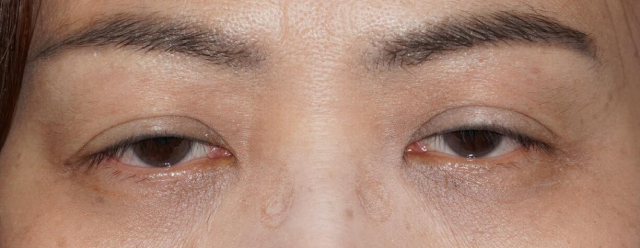
Ptosis can be measured by assessing the distance between the light reflex in the centre of the eye and upper eyelid. If the distance between the light reflex and upper eyelid is lower than 2mm, it is considered functional ptosis which contributes to superior visual field loss. A normal upper eyelid margin is usually 3 to 4 mm from the centre of the pupil.

*Marginal Reflex Distance (MRD) is used in the assessment of the degree of severity of Ptosis
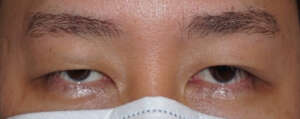


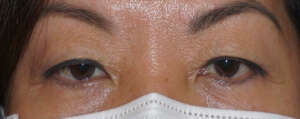

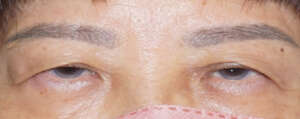
Examples of ptosis concerns prior to surgery
What are the Causes of Ptosis?
There are two common types of ptosis conditions- Aponeurotic Ptosis (aging or surgery-related) or Congenital Ptosis (present from birth due to muscle issues). For other less common types of ptosis, please consult Dr. Looi for an accurate diagnosis.
Aponeurotic Ptosis
- Common in older adults due to aging, frequent eye rubbing, or prolonged contact lens use.
- Caused by:
- Stretching of the levator palpebrae superioris (LPS) muscle.
- Complete detachment of the LPS from the tarsal plate (the firm structure supporting eyelashes).
This condition can be effectively treated with ptosis correction surgery to restore a more natural, lifted appearance.
Congenital Ptosis
- Present from birth, affecting one or both eyelids.
- Caused by:
- Improper development of the levator palpebrae superioris (LPS) muscle.
While surgical correction is available in Singapore, parents should be aware of potential trade-offs and undergo proper counseling before the procedure. In some cases, ptosis is linked to a winking motion (Marcus Gunn phenomenon), requiring careful surgical planning. Additionally, congenital ptosis can be part of blepharophimosis syndrome, which involves other eyelid abnormalities that must be addressed alongside the ptosis treatment.


Medical diagnosis of ptosis condition

Before and after pictures of ptosis surgery

Detailed procedure pathway

Detailed breakdown of the cost of ptosis surgery

Whether patient’s ptosis condition qualifies under Medisave/medical insurance coverage (if applicable)

Post-surgery care
While both conditions lead to a heavy-eyed appearance, they are anatomically distinct. Dermatochalasis refers to the presence of loose, redundant eyelid skin that hangs down over the eye, often due to ageing or loss of skin elasticity. In contrast, ptosis is a medical condition where the actual upper eyelid margin sits lower than it should because the levator muscle (the muscle responsible for lifting the eyelid) has weakened, stretched, or detached from the tarsal plate that lies behind the eyelashes.. Think of dermatochalasis as a hooding effect caused by excess fabric, whereas ptosis is a mechanical failure of the shutter itself.
At Ava Eye Clinic, we carefully distinguish between the two, as treating skin laxity requires a blepharoplasty, while fixing a weak muscle requires specific ptosis surgery to tighten the internal structures.
In a clinical setting at Ava Eye Clinic, we measure the Margin Reflex Distance 1 (MRD1), which is the space between your pupil and the edge of your upper eyelid. A normal eyelid usually rests 3 to 4 mm above the center of the pupil. If that distance drops to 2 mm or less, it is generally considered functional ptosis. Mild cases might only be an aesthetic concern, making you look sleepy or tired. However, moderate to severe cases often lead to a significant loss of the superior visual field. You might find yourself constantly tilting your head back or raising your eyebrows to see clearly, which can lead to chronic forehead tension and headaches. If your eyelid is covering part of your pupil or obstructing your vision, ptosis correction is usually recommended.
Ptosis surgery can be either cosmetic or reconstructive, depending on the severity.
If the eyelid droop is purely an aesthetic concern and does not interfere with your vision, it is classified as cosmetic. However, if a visual field test (conducted here at Ava Eye Clinic) proves that the eyelid is obstructing your sight, the procedure is deemed medically necessary and reconstructive.
In such functional cases, you can typically use your MediSave to offset the costs. As of 2026, the claimable limit is approximately $2,450 per eye.
Generally, yes. Most private Integrated Shield Plans in Singapore provide coverage for droopy eyelid surgery if it is performed for functional reasons. To facilitate this, our specialists at Ava Eye Clinic will perform a comprehensive assessment, including clinical photography and a formal visual field test, to document the degree of obstruction. If your condition meets the Ministry of Health (MOH) criteria for medical necessity, we can assist with the Letter of Guarantee (LOG) from your insurer. It is important to note that congenital ptosis (present from birth) is occasionally excluded by some older policies, so we always recommend a pre-verification check with your insurance provider.
The cost of ptosis correction in a private specialist setting like Ava Eye Clinic typically reflects the complexity of working with the delicate levator muscle. For a single eye (unilateral), surgeon fees generally start from $3500, while bilateral (both eyes) procedures can range from $6000 to $9,000 or more, depending on the surgical technique required and whether the patient is undergoing a revision. These figures usually exclude anesthetist fees, facility charges, and GST. While the upfront cost in private practice is higher than in subsidised public hospitals, patients choose Ava Eye Clinic for the ability to select a specific subspecialised oculoplastic surgeon and for significantly shorter waiting times.
If you only have ptosis in one eye, it is certainly possible to perform a unilateral correction. However, there is a physiological phenomenon known as Hering’s Law, where lifting a droopy lid can sometimes cause the other normal lid to drop significantly. This happens because the brain realises it no longer needs to send extra signals to the upper eyelids to keep the eyes open. During your consultation at Ava Eye Clinic, we perform a clinical test to see how your other eye reacts. If the second eye shows signs of dropping once the more droopy upper lid is lifted, we may recommend a bilateral procedure to achieve the most balanced and symmetrical result.
Post-operative swelling and bruising are most prominent in the first 48 to 72 hours. Most of our patients find that the social downtime lasts about 7 to 10 days.
By the end of the first week, the major bruising has usually faded to a light yellow. By the end of two weeks, most bruising would have resolved. Stitches are usually removed between 7 to 10 days. While you will look presentable within two weeks, it takes about 1 to 3 months for the residual internal swelling to completely settle and for the final eyelid height to be fully established. We provide care advice and specific ointments to help accelerate this healing process.
In the first week following ptosis surgery, it is common to experience lagophthalmos, which is a slight inability to close the eyes completely. This happens because the lifting muscle has been shortened or tightened, while the closing muscle has been disturbed and weakened in the early period. We actively look out for this and prescribe intensive lubricating eye drops and nighttime gels to prevent the cornea from drying out. In the vast majority of cases, this is temporary and resolves over a few weeks. We monitor your eye closure closely during your follow-up visits to ensure your eye remains healthy and hydrated.
Ptosis surgery is designed to be a long-term solution. For most adults with age-related (aponeurotic) ptosis, the results of a levator advancement can last for many years. However, no surgery can stop the natural ageing process entirely. Over a decade or two, the tissues may continue to lose some elasticity, or the muscle may gradually stretch again. Our oculoplastic surgeon employs meticulous dissection and positioning of tissues to minimise the risk of recurrence. While a touch-up may occasionally be needed years down the road, the functional benefits of an unblocked visual field are usually maintained for the long term.
At Ava Eye Clinic, we generally advise against the long-term use of contact lenses following a ptosis correction. The repetitive pulling and stretching of the eyelid involved in inserting and removing lenses can compromise the surgical repair and increase the risk of the eyelid drooping again.
For patients who prefer not to wear glasses, Dr Looi often suggests exploring refractive options like LASIK or other vision correction surgeries prior to undergoing ptosis surgery. Additionally, for our older patients who have cataracts, it is usually more prudent to complete cataract surgery first. This is because the eyelid retractors used during cataract procedures can sometimes stretch the eyelid tissues, potentially undoing the results of a previous droopy eyelid surgery. During your consultation, Dr Looi will meticulously evaluate your eye health and eyelid stability to recommend the safest and most effective sequence for your procedures.
Contact Us
Latest Blog

Ptosis Surgery 2026: The “Natural Look” Preservation Trend